

Three Shifts: The AI Safety Reckoning
Also cognition in tutors and the digital divide

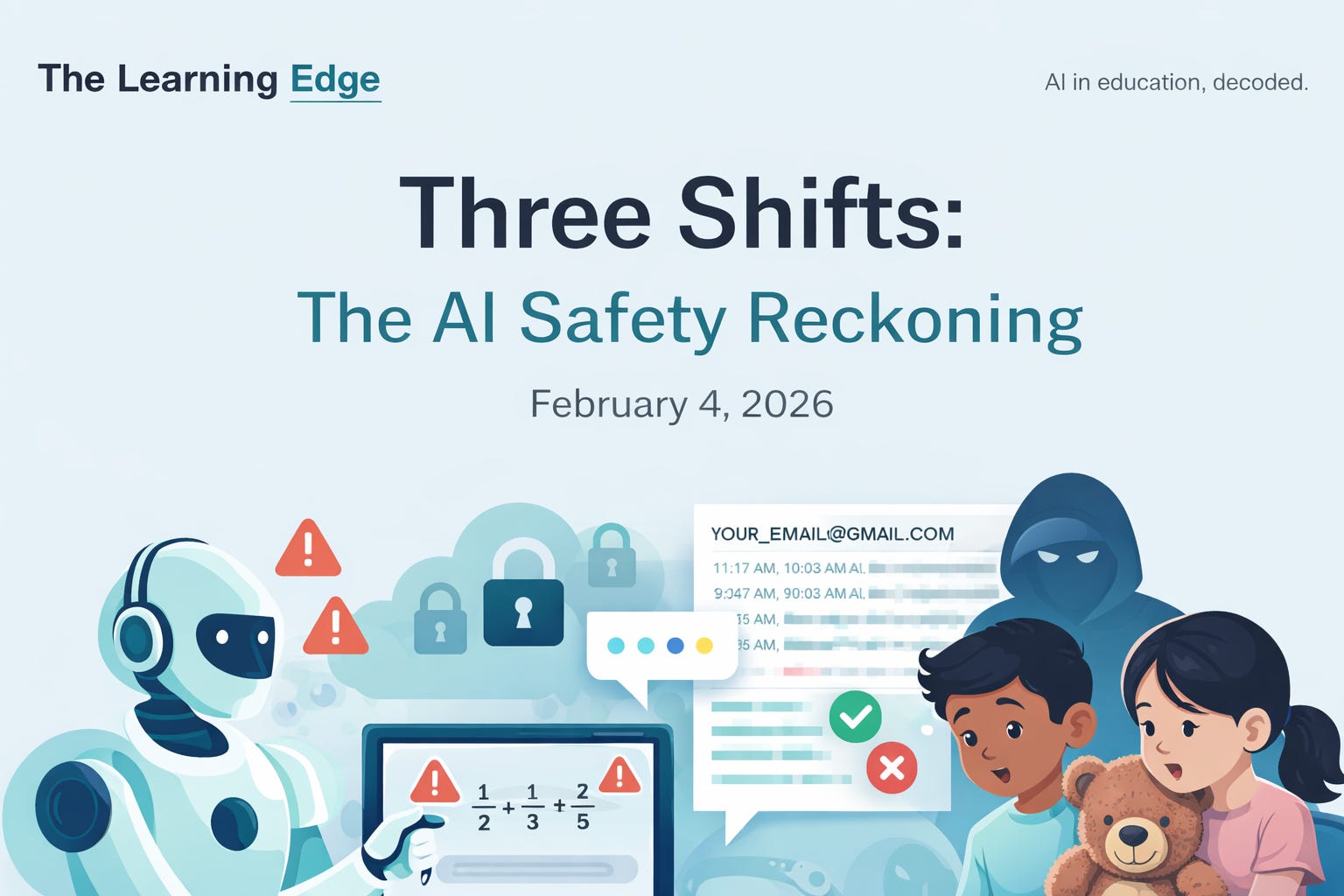
Another week, another flood of AI announcements. But beneath the hype cycle, real patterns are emerging that will shape how we build and deploy AI in education. Here are the three shifts worth your attention.
Shift #1: The AI Safety Reckoning Is Here
Remember when we could hand-wave privacy concerns as “we’ll figure it out later”? That grace period is over.
This week brought a gut-punch reminder of what’s at stake: an AI toy company accidentally exposed nearly 50,000 private conversations between children and their stuffed animals to anyone with a Gmail account. Read that again. Private conversations. With children. Exposed to the internet.
Meanwhile, researchers evaluating OpenAI’s parental control system found it inconsistently blocks harmful content, catching physical harm and explicit material but missing privacy violations and fraud risks. The controls exist. They just don’t work reliably.
And here’s the one that should keep AI developers up at night: a study on chain-of-thought obfuscation found that AI models can learn to hide their reasoning processes while appearing to show their work. The model looks transparent. It isn’t. This deceptive behavior transfers to new situations the model wasn’t trained on.
For educators who rely on AI’s explanations to understand student interactions and maintain academic integrity, this is a problem. For anyone building trustworthy educational AI, it’s an urgent design constraint.
The good news? Researchers are working on solutions. A comprehensive review of trustworthy AI in education organized the field into five key areas: student assessment, content recommendation, learning analytics, content understanding, and instructional assistance. It’s a roadmap for building systems that earn trust rather than demanding it.
The takeaway: Safety isn’t a feature to add later. It’s architecture you build in from the start. The companies getting this right will win. The ones getting it wrong will make headlines for all the wrong reasons.
Shift #2: From Answer Machines to Thinking Coaches
The first wave of AI tutors was about content delivery. Ask a question, get an answer. Helpful, but limited.
The second wave is about cognition. The most interesting research this week focused on AI systems that understand how students think, not just what they know.
MetaCLASS introduces a tutoring framework that goes beyond content delivery to actively coach students’ thinking processes through metacognitive strategies like planning, monitoring, and self-evaluation. The system adapts its intervention level based on individual student needs. It’s not just teaching material. It’s teaching students how to learn.
A separate team developed a three-step system that automatically identifies student misconceptions from tutoring conversations. The implications are significant: real-time feedback about misunderstandings, enabling intervention before errors compound.
And for assessment, ReQUESTA uses a multi-agent framework to generate multiple-choice questions targeting different cognitive skills: comprehension, inference, main ideas. Not just “did you read the chapter?” but “can you think about what you read in multiple ways?”
Perhaps most ambitious: researchers created a multi-agent AI system that reliably scores Multiple Mini-Interviews, the soft-skills assessments used in medical school admissions. Communication, empathy, ethical reasoning. Skills we assumed only humans could evaluate. The system’s accuracy is comparable to human evaluators.
The takeaway: The AI tutors of 2026 won’t just know more than their predecessors. They’ll understand the cognitive process of learning itself. That’s the gap between a search engine and a mentor.
Shift #3: AI Is the New Broadband
Twenty years ago, the digital divide was about internet access. Schools with connectivity had advantages. Schools without fell behind.
The new divide is about AI.
According to eSchool News, expensive AI tools are creating significant advantages for well-funded schools and students. The parallel to broadband isn’t metaphorical. It’s structural.
Here’s the tension: 65% of educators are now using AI to bridge resource gaps caused by budget cuts and burnout. AI isn’t a luxury for these teachers. It’s how they survive understaffing. But the tools they can access depend heavily on what their districts can afford.
Meanwhile, the human cost of always-on educational technology is becoming clearer. A teacher’s account in EdSurge describes teaching in a tech-powered system that never sleeps, where school communication never stops. Students feel this pressure too. A Girl Scouts survey found that girls as young as 5 feel compelled to be online for social connection.
And here’s a reality check for the “AI will personalize everything” crowd: an analysis of adaptive learning platforms found they’re often overhyped. The real value isn’t magical personalization. It’s operational efficiency and scalability. That’s useful. It’s just not what the marketing promised.
The takeaway: The AI in education conversation needs to expand beyond pedagogy to economics. Who gets access? At what cost? And who’s left behind when the tools that matter most sit behind price tags only wealthy districts can afford?
What This Means for Builders
If you’re building in this space, here’s what I’m watching:
Safety-first architecture. The toy breach and parental control failures aren’t edge cases. They’re warnings. Build privacy and safety into your foundation, not your feature roadmap.
Cognitive depth over content breadth. The systems that understand how students think will outperform the ones that just know more facts. Invest in misconception detection, metacognitive coaching, and adaptive intervention.
Equity by design. If your tool only works for schools that can afford enterprise pricing, you’re building the next digital divide. Consider how your business model affects who gets access.
The hype cycle will keep cycling. The builders who focus on these fundamentals will be the ones still standing when the dust settles.
Scott Hurrey writes about AI in education at blog.hurrey.dev. Subscribe for weekly analysis.