

The Great EdTech Land Grab
Why Big Tech is Suddenly All-In on Education AI

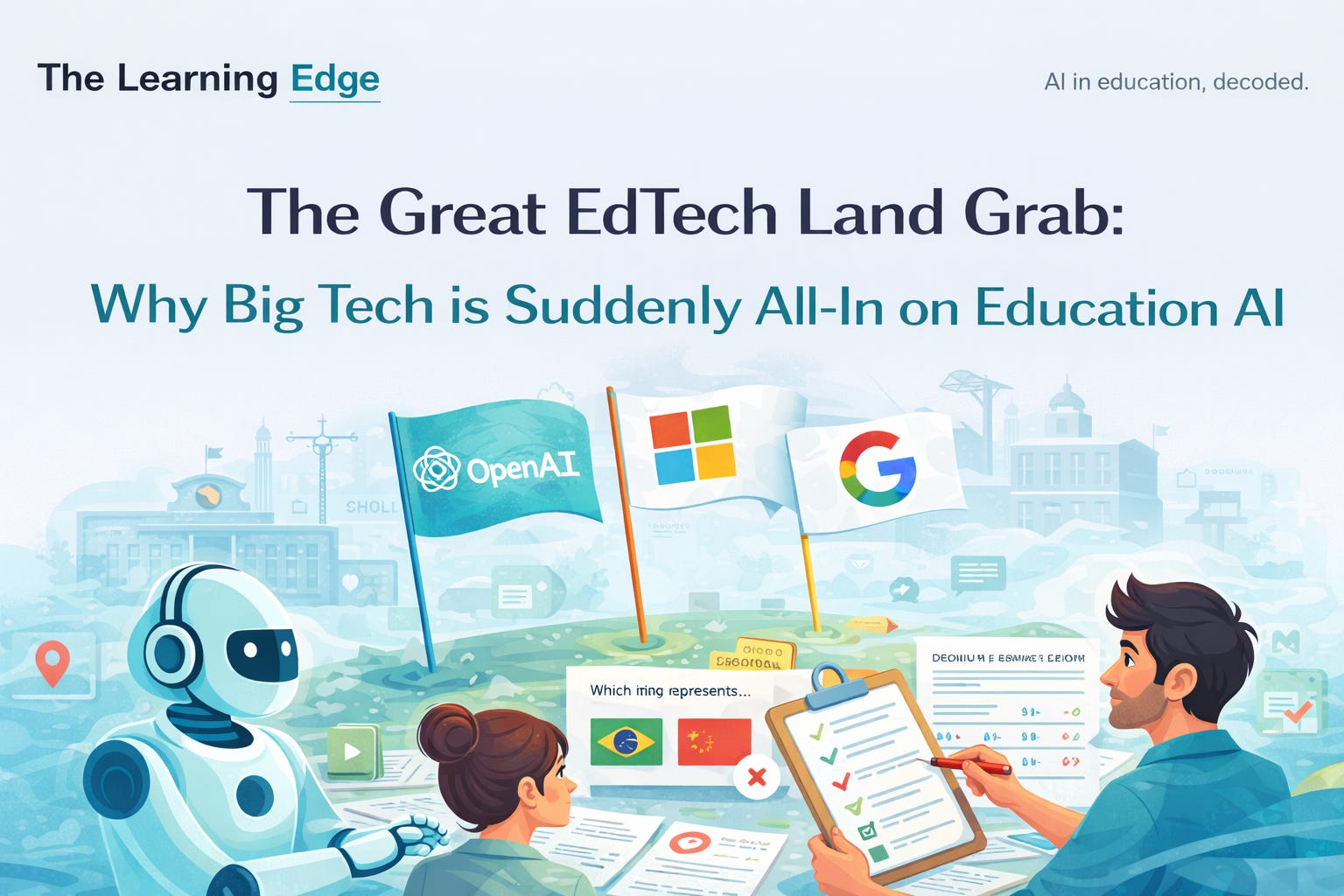
Something interesting is happening in education technology right now. Microsoft, Google, and OpenAI are all making aggressive moves to capture the classroom at the same time. This isn’t a coincidence. It’s a calculated land grab.
OpenAI Enters the Chat (Literally)
Last week, OpenAI released Study Mode, a feature specifically designed for education. Unlike standard ChatGPT, Study Mode doesn’t just hand students answers. It uses scaffolded reasoning and adaptive feedback to guide learners through problems step by step.
What’s notable here: OpenAI built this with educators, not just for them. That’s a meaningful shift. The company that popularized “ask AI anything” is now building guardrails specifically because teachers asked for them.
Study Mode is available across subscription tiers, including free accounts. OpenAI isn’t trying to monetize education directly. They’re trying to become the default AI tool for a generation of students.
Google Goes Credential-Heavy
Google is taking a different approach. They just announced Gemini certifications for education, creating formal training pathways for educators who want to develop AI competencies.
They’re also launching Google Scholar Labs, using AI to help researchers navigate academic literature. And their interactive images in Gemini feature is designed around learning science principles.
Google’s play is institutional. Get schools to certify teachers in Gemini. Build tools that integrate with existing Google Workspace for Education deployments. Make the switching costs enormous.
Microsoft Bets on Copilot
Microsoft has been the most aggressive. Their AI in Education Report found that 80% of educators have used AI. That’s not a future trend. That’s today’s reality.
Their response: a full suite of Microsoft 365 Copilot tools designed specifically for education, including a free academic version of Copilot. They’ve also launched Elevate Washington as a pilot program giving priority AI access to local students.
Microsoft is playing the long game they know well: get embedded in institutions, become essential, then upsell forever.
Why This Matters
Education is one of the last major sectors without a dominant AI platform. Healthcare has regulations. Finance has compliance requirements. But education? Schools are desperate for AI tools that actually work, and no one has locked in that market yet.
The student who learns on ChatGPT becomes the professional who pays for ChatGPT. The teacher certified in Gemini influences their entire school’s purchasing decisions. The district running Microsoft 365 Education is pre-sold on Copilot.
This is platform lock-in at its most strategic.
What Educators Should Do
Don’t get locked into one ecosystem yet. These tools are evolving fast, and today’s best choice might be next year’s legacy system.
Focus on AI literacy, not specific tools. Teach students how to prompt, how to verify AI outputs, how to think critically about generated content. Those skills transfer across platforms.
And pay attention to who’s building with educators versus at them. The tools designed with teacher input are consistently better than those designed by engineers who haven’t seen a classroom since high school.
The land grab is real. Make sure you’re the one making the choice about which tools enter your classroom.