

The Critical Thinking Paradox
When AI Helps vs. Hurts Student Thinking

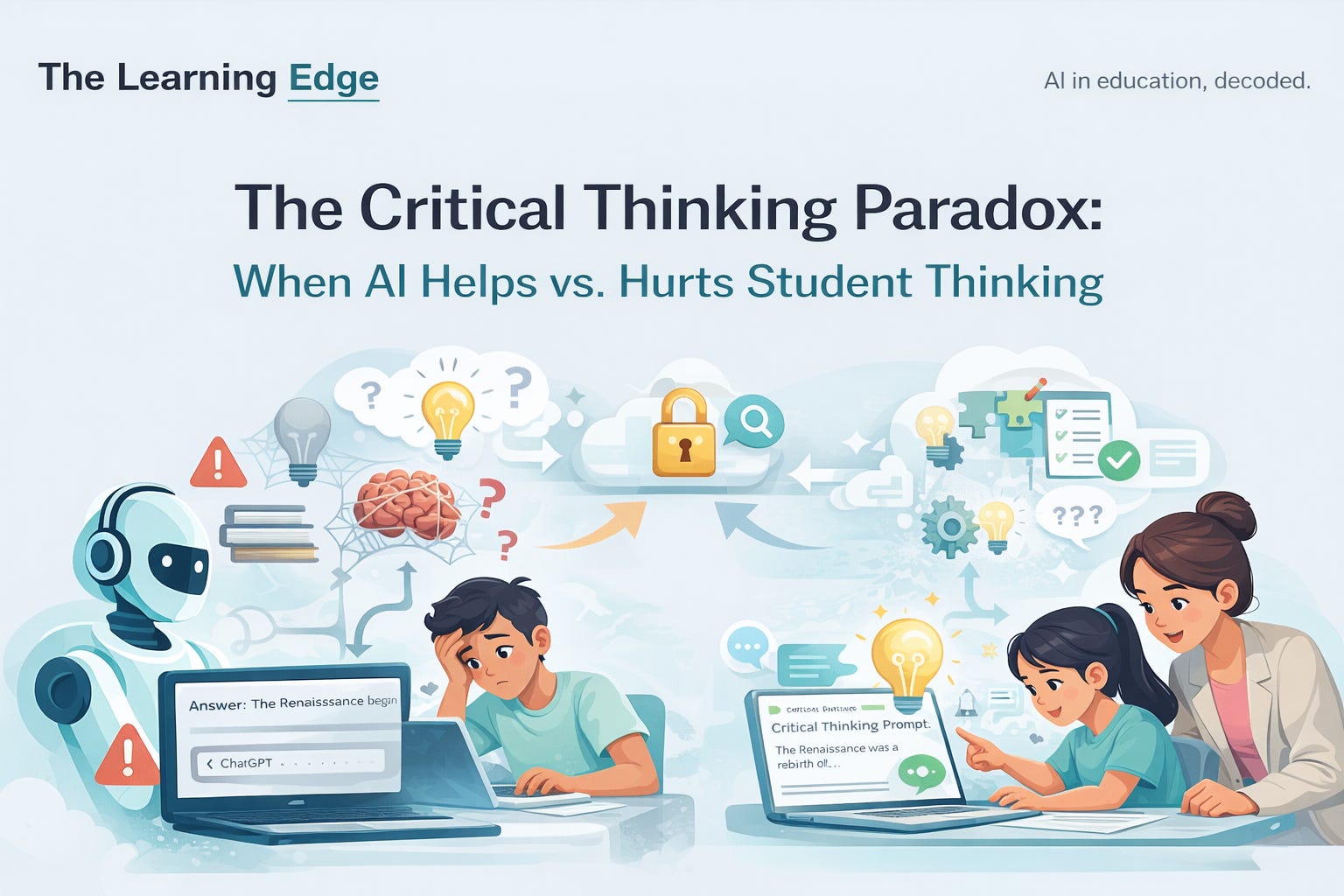
Two studies dropped this week with seemingly opposite conclusions about AI in education. One warns that uncritical AI adoption may harm students’ critical thinking. The other found that teacher-led AI activities actually strengthen it.
So which is it? Both. And that distinction matters more than most realize.
The Warning Shot
Researchers published findings in arXiv this week arguing that AI adoption in education may harm students’ critical thinking, autonomy, and emotional well-being through cognitive offloading and surveillance practices. The concern isn’t theoretical. When students outsource their thinking to AI, they miss the cognitive struggle that builds genuine understanding.
Think of it like GPS navigation. Convenient? Absolutely. But studies show heavy GPS users develop weaker spatial reasoning. They arrive at destinations without ever learning to navigate. The same risk applies to AI in education: students might get answers without developing the mental muscles to find them independently.
The Counter-Evidence
Meanwhile, analysis of over 23,000 teacher-created AI classroom activities found something different. When educators lead AI design and implementation, the technology actually strengthens rather than replaces critical thinking. Teacher-guided AI use deepens instruction and boosts student engagement across subjects and grade levels.
The key phrase: teacher-led.
The Paradox Resolved
These findings aren’t contradictory. They’re describing two different implementations of the same technology.
Uncritical adoption means handing students AI tools without scaffolding, without intentional design, without teacher guidance. It’s “here’s ChatGPT, good luck” pedagogy. That approach absolutely risks cognitive offloading.
Teacher-led implementation means designing activities where AI amplifies rather than replaces student thinking. It’s using AI to pose better questions, provide immediate feedback, or explore scenarios. The teacher remains the architect of the learning experience.
The difference isn’t the technology. It’s the pedagogy around it.
What This Means for Educators
If you’re integrating AI into your classroom, the question isn’t whether to use it. It’s how intentionally you’re designing around it.
Ask yourself:
Does this activity require students to think critically, or does AI do the thinking for them?
Am I using AI to scaffold toward independence, or creating dependence?
Who controls the learning experience: the technology or the teacher?
AI doesn’t automatically help or harm critical thinking. Implementation determines the outcome. The research this week makes that clearer than ever.
In Other News
Assessment research also made waves this week. Researchers developed AI systems providing trait-based feedback on argumentative essays rather than just holistic scores. More specific feedback means students can target specific weaknesses in their writing.
And for online testing, theory-based messaging interventions reduced cheating by 42% while maintaining student performance. This demonstrates evidence-based academic integrity strategies that actually work.
Subscribe to The Learning Edge for daily analysis on AI in education.