

The Amplifier Effect
AI in education doesn’t create new problems. It makes the old ones impossible to ignore.

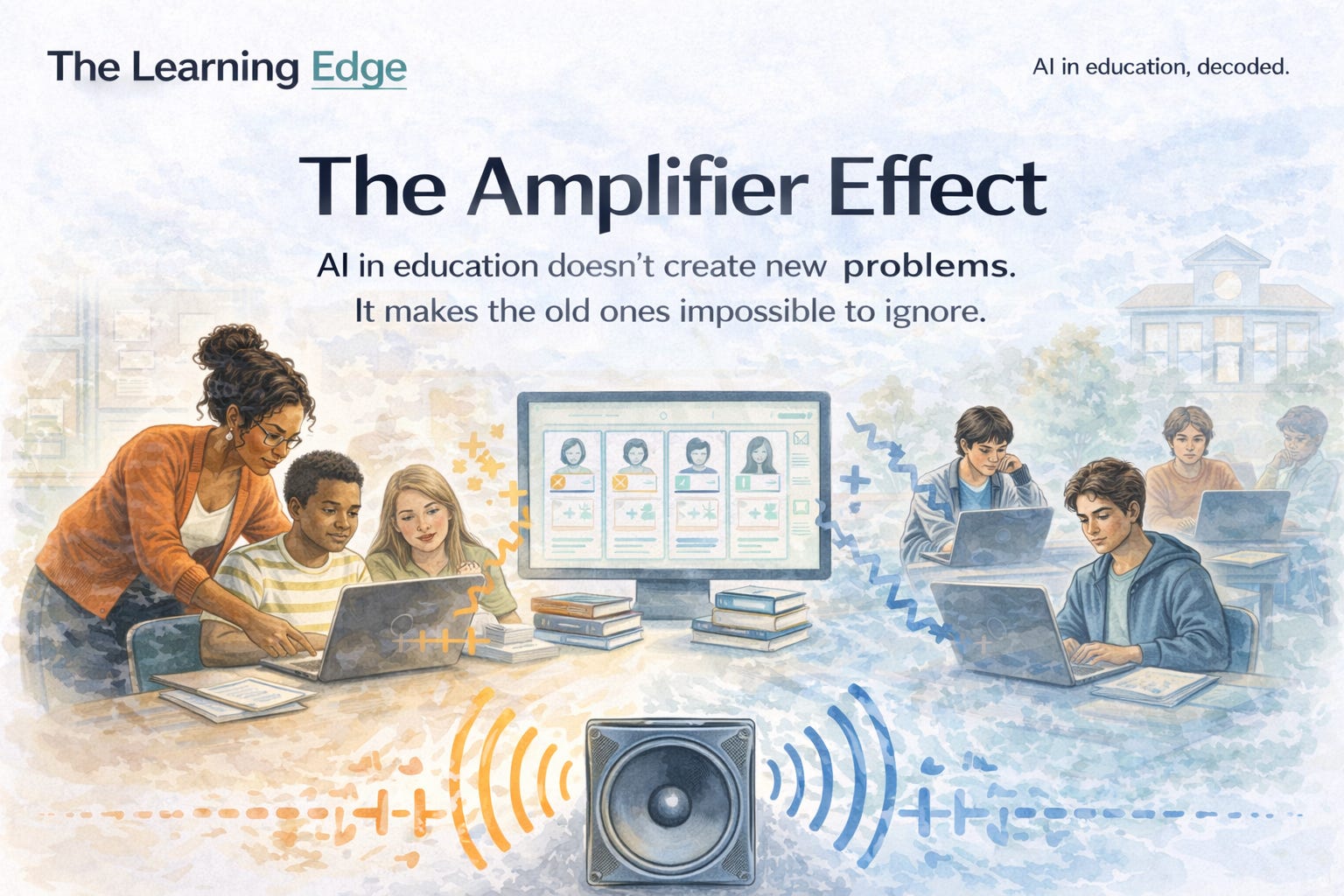
A new study from NC State tracked over 1.4 million student interactions in AI-powered math tutoring classrooms. The finding was uncomfortable. When teachers had dashboards showing which students needed help, they kept helping the same kids over and over. Researchers called it “sticky help.” The students who got attention early kept getting it. The rest fell further behind.
The AI didn’t cause the bias. It revealed it.
That pattern tells you something important about where we are right now. AI in education is acting as an amplifier. It takes whatever approach, habit, or blind spot is already in place and turns up the volume.
The Adoption Nobody Planned For
Here’s a number that should make every provost sit up straight. A Gallup and Lumina Foundation study of 4,000 college students found that 57% now use AI daily or weekly for schoolwork. That’s not early adopters. That’s the majority.
But 53% of those same students say their institution discourages or bans the use of AI. And 52% say they lack clear guidance on AI policies in their courses.
Read that again. More than half of students are using AI regularly. More than half say their schools haven’t told them how.
A separate California State University survey of 94,000 people found almost identical numbers. 95% have tried an AI tool. 53% use it regularly. 82% of students worry about what AI means for their careers.
Students aren’t waiting for institutional permission. They’re building habits, developing workflows, and forming assumptions about what’s acceptable. All without guidance. The preparation gap isn’t coming. It’s here.
AI Won’t Fix Bad Pedagogy
This connects to something larger. A sharp opinion piece in eSchool News from Jill Diniz and James Tanton argues that high school math is still taught using outdated, fragmented standards. Their point is blunt. Layering AI on top of a broken framework doesn’t fix the framework. It automates the flaws.
They’re talking about math. But the principle applies everywhere.
If your course design already leans on rote memorization, AI tools will make it easier to skip the memorizing entirely. If your assessment strategy relies on take-home essays, AI will render them indistinguishable from student work. If your teachers already gravitate toward certain students, AI dashboards will make that pattern more efficient.
A Frontiers in Education study surveyed STEM teachers before and after professional development on generative AI. The teachers were optimistic. They could see the potential for personalization and engagement. But they flagged the same barriers over and over: not enough training, too many ethical gray areas, and genuine confusion about how to do this well.
The gap isn’t enthusiasm. It’s preparation.
What the Amplifier Demands
The amplifier effect means that institutional readiness matters more than tool selection. You can buy the best AI tutoring platform on the market. But if your teachers haven’t examined their own help patterns, you’re just scaling bias faster.
Invest in teacher awareness before teacher tools. The NC State study showed that teacher interventions produced real learning gains within individual sessions. Teachers aren’t the problem. Unconscious patterns are. Dashboard designs that surface interaction equity data could help. But only if teachers are trained to look at it and act on it.
Write clear AI policies now, not eventually. Half of your students don’t know what’s expected of them. That’s not a student failure. That’s an institutional one. The policy doesn’t need to be perfect. It needs to exist, be visible, and be updated regularly.
Redesign before you deploy. If you know your math curriculum is built on fragmented standards, adding an AI tutor won’t solve the fragmentation. Fix the pedagogy first. Then let AI amplify something worth amplifying.
The Volume Keeps Going Up
The AI in education market hit $10.6 billion this year and is projected to reach $42.5 billion by 2030. The tools aren’t slowing down. The investment isn’t slowing down. Student adoption definitely isn’t slowing down.
The only thing that can slow down is the gap between what’s being used and how well people are prepared to use it.
AI is an amplifier. Right now, in too many classrooms and institutions, it’s amplifying neglect. Not because anyone chose that. Because nobody chose otherwise.
The volume is going up whether we’re ready or not. The only question is what we’re feeding into the speaker.
The Learning Edge publishes twice weekly on the intersection of AI and education. If this resonated, share it with a colleague who’s navigating these questions too.