

AI That Reads the Room
The Shift From Content Delivery to Cognitive Understanding

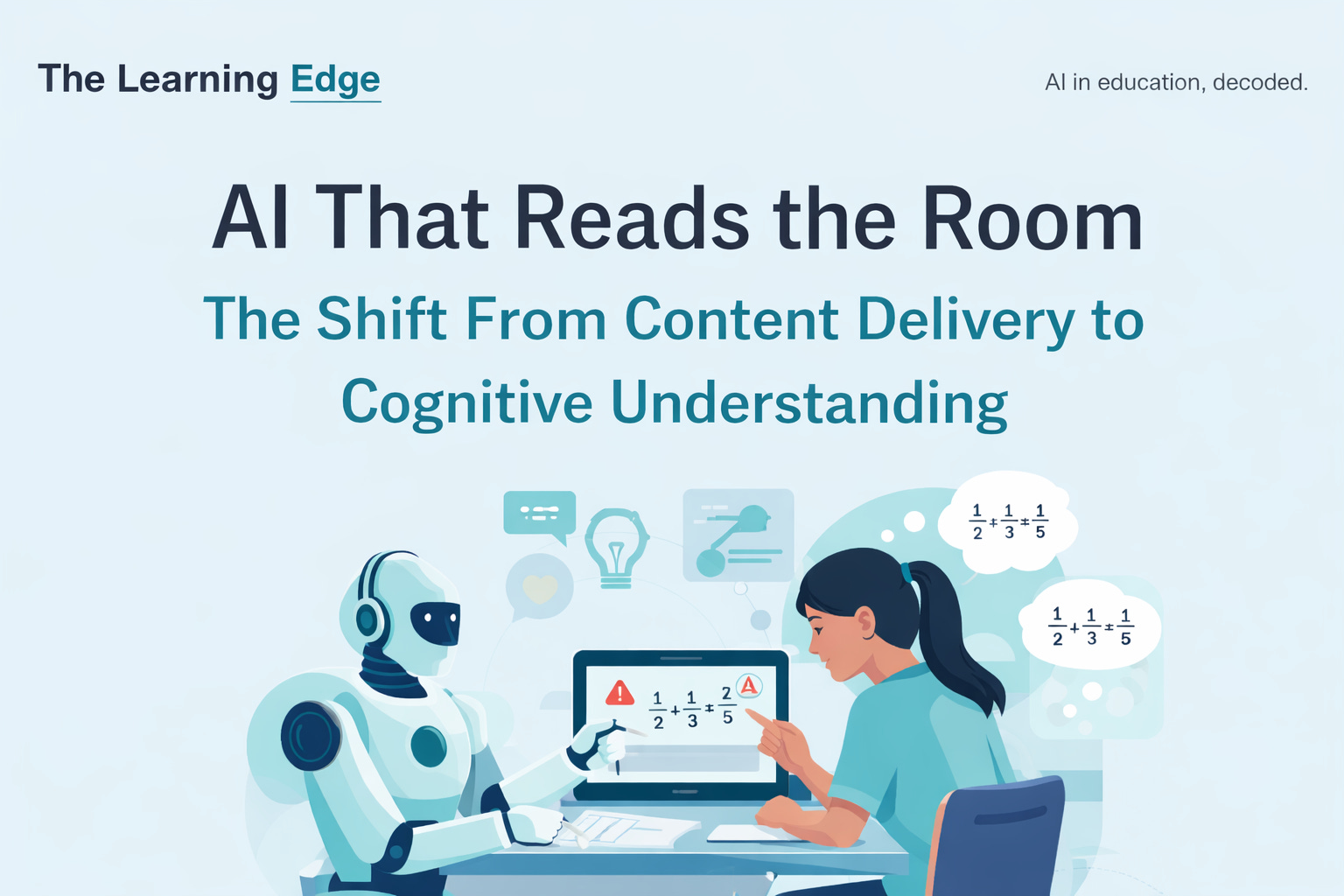
For years, ed-tech AI has focused on one question: *Does the student have the right answer?*
Two papers published this week suggest we’re finally asking better questions: *Why did the student get it wrong? And how are they thinking about it?*
Beyond Right and Wrong
The first breakthrough comes from researchers who are tackling misconception diagnosis in tutoring conversations. Their three-step system (generate, retrieve, rerank) analyzes student-tutor dialogue to automatically identify the specific misconceptions behind wrong answers.
This matters more than it sounds. A student who thinks 1/2 + 1/3 = 2/5 has a different problem than one who thinks it equals 1/5. Both answers are wrong, but the errors reveal completely different misunderstandings. Traditional ed-tech treats them identically. This system doesn’t.
The implications for real-time intervention are significant. Instead of flagging “incorrect” and moving on, an AI tutor could recognize *why* the student is struggling and address the root cause before the misconception compounds.
Teaching Students How to Think
The second paper, MetaCLASS, takes this further. Rather than just delivering content, this AI tutoring framework coaches students’ metacognitive processes: planning, monitoring, and self-evaluation.
Think about what that means. The AI isn’t just asking “Do you understand photosynthesis?” It’s prompting “How confident are you in that answer? What would you check to verify it?”
The system adapts its level of intervention based on individual needs. Students who already self-regulate get lighter touches. Those who don’t get more scaffolding. It’s the kind of differentiated instruction every teacher aspires to, but few have the bandwidth to deliver consistently.
This is something I think about with my own daughter. She is a freshman in college, and I saw her struggle with the transition from high school. I built her an AI-based time management and study tool to help her. I didn’t build it to give her answers. I built it to help her learn how to get the answers.
The Uncomfortable Question
Here’s where it gets complicated. These tools are powerful. They represent genuine advances in understanding student cognition.
And they will be expensive.
An eSchool News analysis this week argues that access to AI is becoming the new digital divide. Just as broadband internet created educational inequalities in the 2000s, access to sophisticated AI tutoring tools could widen achievement gaps further.
The irony is sharp. We’re building AI that finally understands how students think. The question is whether all students will get access to it, or just the ones in well-funded districts.
In my own experience, building the tool to help my daughter was time well spent. I am lucky to have the expertise, the means, and the access to do so. Not every kid is in that position.
What This Means for Educators
If you’re in a position to pilot these tools, the misconception diagnosis approach is worth watching. Real-time identification of student misunderstandings could transform formative assessment.
If you’re not, the underlying principle still applies: the *type* of error matters more than the fact of the error. That’s true whether AI detects it or you do.
The shift from “right or wrong” to “why wrong” isn’t just a technical advance. It’s a pedagogical one. The AI is finally catching up to what good teachers have always known.
*The Learning Edge covers AI in education. Subscribe for daily analysis.*
It really is something that we need to get right. And we have to do what we can to make sure every student has access.